Skip to content
  • Young in the Mountains Young in the Mountains
  • Shop
    • In stock
    • Custom made : within 7 weeks
    • Gem library : within 7 weeks
  • process
    • Artistry
    • Sourcing
  • story
    • About us
    • Our mission
    • Ethics
Young in the Mountains Young in the Mountains
  • Book Appointment
  • Log in
  • 0 Cart (0 items)
ALL POSTS

Understanding the Differences Between Turquoise, Variscite, and Variquoise
Understanding the Differences Between Turquoise, Variscite, and Variquoise

Understanding the Differences Between Turquoise, Variscite, and Variquoise

Turquoise is a well-known gemstone, recognized for its distinct blue-to-green colors. Less familiar, however, are variscite and the natural mineral combination known as variquoise. This article explores the scientific differences between these minerals and explains what distinguishes each gemstone clearly.

Turquoise: Copper’s Blue-Green Influence

Turquoise is a phosphate mineral composed primarily of hydrated copper and aluminum phosphate (CuAl₆(PO₄)₄(OH)₈·4H₂O). Its distinctive blue-to-green colors result from copper within its chemical structure. The presence of iron and zinc can further influence turquoise’s color intensity and hue, causing the variations between vibrant blue and greenish tones. The presence of dark matrix patterns often seen within turquoise comes from surrounding host rock materials, typically limonite or sandstone.

Variscite: A Chromium-Aluminum Connection

Variscite, often confused with turquoise due to superficial similarities, has notable chemical differences. Variscite is a hydrated aluminum phosphate mineral (AlPO₄·2H₂O), lacking copper. Instead, its characteristic green shades primarily come from traces of chromium or sometimes vanadium. Variscite typically presents colors ranging from pale mint greens to deeper emerald-like hues, without the characteristic blue coloration seen in turquoise.

Chemically, the absence of copper clearly differentiates variscite from turquoise. Moreover, variscite is generally softer and more porous, scoring around 3.5 to 4.5 on the Mohs hardness scale, compared to turquoise’s hardness of about 5 to 6.

Variquoise: A Natural Hybrid

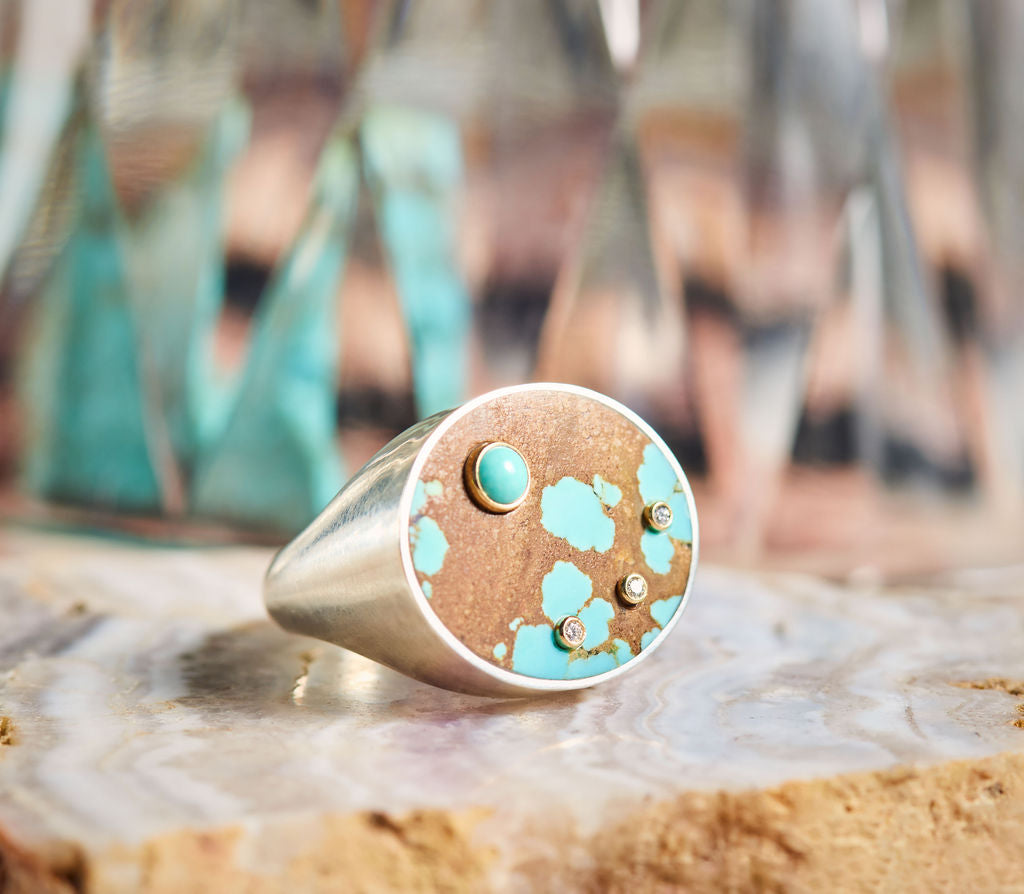
Variquoise is a mineral specimen displaying a natural combination of turquoise and variscite. In geological environments where conditions fluctuate, copper-rich turquoise and aluminum-dominant variscite may occur together, forming distinctive mixed mineral compositions. The result is a gemstone featuring a combination of blue and green tones with patterns unlike those seen in either turquoise or variscite alone.

Distinguishing Characteristics: Turquoise, Variscite, and Variquoise

  • Chemical Composition:

    • Turquoise: Hydrated phosphate of copper and aluminum (CuAl₆(POâ‚„)â‚„(OH)₈·4Hâ‚‚O).

    • Variscite: Hydrated phosphate of aluminum (AlPO₄·2Hâ‚‚O), with chromium or vanadium providing green coloration.

    • Variquoise: A naturally occurring mixture of turquoise and variscite minerals, chemically heterogeneous.

  • Color and Appearance:

    • Turquoise: Blue to bluish-green, influenced primarily by copper.

    • Variscite: Green shades ranging from pale mint to emerald green, due to chromium or vanadium.

    • Variquoise: Mixed blue-green hues, presenting patterns indicative of a hybrid mineral structure.

  • Geological Formation: These phosphate minerals typically form within rock fissures or cavities through precipitation from phosphate-rich groundwater solutions, influenced by specific geological and chemical conditions.

Considerations for Selection

Choosing among turquoise, variscite, or variquoise depends largely on aesthetic preference and appreciation for geological uniqueness. Scientifically, these minerals offer insight into the conditions and chemistry of the regions where they formed, making them subjects of interest beyond their visual appeal.

Explore our collection to find examples of turquoise, variscite, and variquoise, each showcasing distinct chemical and geological characteristics.
FACEBOOK
Share on Facebook
PINTEREST
Pin on Pinterest
EMAIL
Send email

More Posts

ALL POSTS
Ruby vs. Sapphire: Same Mineral, Different Story—Starring the Treasures of Montana

06/18/2025

Ruby vs. Sapphire: Same Mineral, Different Story—Starring the Treasures of Montana

READ MORE
Precision Crafted: Geometric Cut Gemstones

05/25/2025

Precision Crafted: Geometric Cut Gemstones

READ MORE
Redefining Commitment: How Sustainable Wedding Rings Are Shaping the Future of Love

05/25/2025

Redefining Commitment: How Sustainable Wedding Rings Are Shaping the Future of Love

READ MORE
Why Your Gold Ring Turns Your Finger Green—And What Sunscreen Has to Do With It

05/25/2025

Why Your Gold Ring Turns Your Finger Green—And What Sunscreen Has to Do With It

READ MORE

Invalid Password
Enter

Keep in touch

Updates, New Releases & Sales

Help

  • FAQs
  • Warranty
  • Resize & Repair
  • Terms Of Service

Education

  • Journal
  • Jewelry Care


    Illustration of brush in a cup for jewelry care

    Cleaning Your YITM Jewelry

    Gold, Diamonds & Sapphires
    These materials are the most durable and easiest to clean. Use warm water, a small amount of mild dish soap, and a soft toothbrush to gently remove buildup. Rinse thoroughly and dry with a soft, lint-free cloth. Avoid harsh chemicals, and abrasive materials. Jewelry with exclusively gold and diamonds or sapphires can go in ultrasonic cleaners. The gold parts of the jewelry can be shined with the polishing cloth included in all YITM orders. 

    Inlay Jewelry
    Inlay pieces require special care. Do not soak or submerge in water. Do not put in an ultrasonic machine. Clean gently with a soft, dry cloth only. Moisture and chemicals can occasionally change the color composition of soft turquoise and variscite stones. Remove when applying lotion, oil, cleaning or swimming. The gold parts of the jewelry can be cleaned with the polishing cloth included in all YITM orders. 

    Sunstones, Tourmaline, Topaz, Garnet, Amethyst or Peridot
    These stones are more delicate. We do not use them in rings for this reason. If these stones are in your other YITM styles, do not use ultrasonic cleaners, steam, or harsh cleaners. Wipe gently with a soft, slightly damp cloth if needed, then dry immediately. The gold parts of the jewelry can be cleaned with the polishing cloth included in all YITM orders. 


    Storage & Long-Term Care

    Store each piece separately to prevent scratching, ideally in a soft pouch or lined jewelry box. Keep jewelry away from humidity, extreme temperatures, and direct sunlight. Periodic professional inspections are recommended for rings worn regularly.

    For everyday, forever wear, we recommend a simple pure gold band. Our inlay and accent jewelry is best worn as the occasion permits. Please visit our FAQ page for more detailed care guidance.

  • Heirloom Renovation
  • Ring Crown Try On
  • Buying Guide

Find us

  • Contact
  • Retailers
  • Instagram
  • Pinterest
  • Appointments

Company

  • Our story
  • Ethics
  • Gift cards
  • Customer stories
  • Copyright 2026 Young in the Mountains

Shopping Bag

sub total $0.00

CONFIDENT PURCHASE

To ensure your expectations are in alignment with our studio practices, please read the CONFIDENT PURCHASE FAQ

Continue Shopping Go to checkout

Your cart is empty

Continue Shopping

Sentimental Information

We love hearing your stories! This helps us connect with you while we are crafting your piece. It makes you real to us. The power of jewelry is to connect us, to make us remember, and honor an experience. This beauty we create is not surface deep, our jewelry is here to add sentiment into our daily lives. Please, oh please, give us a few words about you, and your story. It will make our hearts full!

Skip this step and take me to checkout
back